The Two-Hour Lunch

The Two-Hour Lunch

In the United States, lunch is often a hurried trip to the vending machine, or the company cafeteria, or from a sack lunch you bring from home. Others make lunch a business appointment with a valued or prospective client.

In Natal, Brazil, the culture for lunch is much different. Two-hour lunches are a way of life there. Many stores close between noon and two. Ironically, at lunchtime one day when I wanted to buy bread at a neighborhood bakery, the store was closed. Even those businesses that depend on customers to buy their food close at what would be the busiest times at Panera or Subway.

Brazilian noon meal in Dr. Carlan’s home

I interviewed a successful dentist, Dr. Carlan, about the appointment schedule of the professional. A dentist for 33 years, he told me that he closes his office from noon to 2:00 and then works until 8:00 p.m. each day. When he was younger he would see patients even later than 8:00.

Lunch is the large meal of the day for Brazilians, and the meal at night is food that is light; soup is very common for the evening meal.

Our busiest times for reading appointments were what is the dinner hour for us in the United States: 6:00 to 8:00 p.m.

Conducting business for Americans in Natal would require adjustments in our eating habits. I have always had trouble keeping mentally alert after lunch. You can imagine what challenges I have with the two-hour main mealtime of the day.

The Brazilian approach to lunch would give more credence to Adele Davis’s words, “Eat breakfast like a king, lunch like a prince, and dinner like a pauper.”
Winter in Natal

I do not like winter! I don’t like waking up on a January morning when the temperature is below zero and six inches of snow are on the ground. The forecast is very cold and a threat of more snow.

Winter in Natal, Brazil, in July was not so bad. When I awakened in the morning, the windows were open, I felt a cool breeze, and the temperature was in the low sixties. The trees with green leaves were interspersed between palm trees and a variety of exotic flowers.

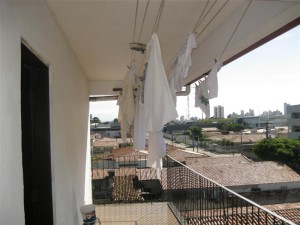
I knew that was the rainy season there; if the sun was shining, I realized that in 20 minutes it could be raining. That did not bother me because an hour after the rain stopped, the sun was shining again. We hung our clothes on the line outside our apartment door and they were dry in just a few hours.

The high temperature was not eight degrees, but the low eighties. For lunch we walked to the portable restaurant a block up the street for a freshly grilled chicken and walked a few yards more for a Coke and fruit at the neighborhood market.

Instead of putting on boots, I had to decide whether I wanted to wear sandals or Dockers with no socks. I’m not sure anyone there owns a pair of gloves. Our big concern was whether we should take an umbrella with us.

I have to admit I looked forward to DQ and grocery stores without lines. But no more can I say I hate winter—at least not in Natal.

Making Your Space Count

In the neighborhood where we work, residents do not have much space for a yard. The churchyard is about 4 feet by 20 feet and that is probably the only yard space in the immediate community.

The median between street lanes and space between the sidewalk and the street, however, has been put to good use by the neighborhood inhabitants. For example, even though a section of the median is used as a small landfill, about 100 feet away there is a stretch of concrete about 4 feet by 30 feet that has been taken over by elderly men in the community. One gentleman is out by 6:30 most mornings checking out “their” space. He will look for trash, pull a weed, and about once a week bring a bottle of liquid that he uses to scrub any stains on the concrete slab. He sits and “protects” the area until his buddies arrive an hour or two later. Someone brings the card table and dominoes and the rest of the morning is spent determining the domino champion.

One morning I was on the sidewalk waiting for a ride when I noticed a man across the street bringing out a birdcage from his home. I saw a bird in the cage, and as I watched, the man went to a young tree that was surrounded by a lattice. The man opened a door built into the lattice and inserted the cage. I could barely see a platform for the cage as he closed the door and walked away. The bird had an outdoor home during the day even though his owner had only a street front apartment and no yard.

I never think of conserving space or making better use of the space I have in the United States. But when your space is limited, you see what space you do have in a different light.

As Joseph Campbell wrote, “Your sacred space is where you can find yourself again and again.” I am inspired by the way people find ways to find themselves again and again. Once we find ourselves, we are more equipped to help others.

Round It Off!

In Brazil you don’t have to worry about getting too many pennies in your purse or pocket. There are no cent coins. Everyone rounds off to the nearest whole amount.

Their currency, the real, pronounced HAY-EYE, equals 100 cents and is worth about 50 cents on the U. S. dollar. The direct two-to-one exchange rate makes it easy to know how much something costs in the currency I’m most familiar with. But their inattention to small change helps even more.

When I give more than needed to a cab driver or the neighborhood grocer, he or she rounds off my change to the nearest real. At the supermarket, the cashier rounds to the nearest cent, so even if the amount shows R$27,32, I’m only charged R$27,30. (Yes, their use of commas and periods in money amounts is the opposite of ours.)

Tipping is not expected in restaurants or when taking a cab. If you have a large group, a 10% surcharge is added. No calculations needed.

Buses do not run on a schedule most of the time, so you don’t have to worry about making the 3:13 bus. You just get to the stop in the general time period you want a ride and always plan on arriving earlier versus later. So again, you can round off your leaving time.

Worship services generally are liberal about starting time. In the five weeks we have been here, if you arrive five minutes after the designated starting time, you will definitely be on time, and possibly so at ten minutes after. So just assume you need to be present around 10:00 a.m., more or less. (“More or less” is a common Brazilian expression so our students learned the English for that early on.)

These examples show why there is a more relaxed atmosphere in conducting day-to-day activities in Brazil than there is in the United States.

So now when my Kroger bill is $8.65 and I give the cashier $9.00, I can’t leave right away. I must remember to wait for my change!

Thumbs Up!

I speak no Portuguese, and English is not a common language here in Natal, Brazil. But after much trial and error, I have found that one nonverbal cue seems to be understood by all. That is the thumbs-up sign.

(In the 50s, Vice President Richard Nixon was not aware of this and insulted the entire nation of Brazil by giving the forefinger to thumb A-OK sign! If he’d only chosen the thumbs-up signal….)

On several occasions I have attempted to explain something to a cab driver, a cashier, or a person I am seeking information from. After much waving of hands and a variety of facial expressions, hoping the other person will understand, he or she will show the thumbs up expression to indicate “I understand,” or “I will do it.” Of course that is usually complemented by a smile. But I never realized such a simple nonverbal cue could be so rewarding.

Fortunately, our American missionary host, Cris, speaks Portuguese as well as a Brazilian, so for most of the difficult communication times I will wait until she is available. She will call a cab, give me directions, or accompany me on an errand. I usually smile and nod my head as though I know exactly what Cris is saying on my behalf.

I am aware that the thumbs-up sign is not universally accepted. In fact, there are countries where that sign is an insult. I understand that some research is necessary before I travel in other countries. But for now, thumbs-up works for me.

I fear that when I get back to the States I will continue conversing with the thumbs up sign at the ends of conversations. I’ll simply nod my head and smile as my wife seeks information or talks to a cashier. Good thing for me that it’s acceptable in the United States as well as Brazil.

Let’s Have a Bonfire!

I always thought of bonfires as a way to celebrate an important victory in sports or as a campfire for roasting hot dogs and making S’mores. I did not know that the bonfire is also believed to keep evil spirits away.

On our way back to our apartment in Natal a few days ago, we saw bonfire after bonfire along the road among small communities as we drove a 20-mile stretch of highway. No one seemed to be attending the fires and no one was standing by the fires roasting hotdogs or creating S’mores over the hot flames. I kept thinking what a fire hazard each unattended glowing fire was.

We quickly began counting and saw over 400 bonfires during our drive back, many in Natal. We could not imagine why there were so many fires.

We did some checking with Brazilian friends and found out this night was the eve of St John the Baptist Day in Brazil. On this night each family builds a bonfire to ward off evil spirits—or simply as a tradition.

This experience demonstrated again that meaning is in people. A bonfire now has a new meaning for me to go along with celebrating activities and having a good time eating special “junk food” under the stars.

From now on I will probably think of the evil spirit meaning first and other more common uses of the bonfire second. Who knows? Maybe in all of my experiences with bonfires, I unknowingly was getting rid of evil spirits!


Check Your Attitude

One of the keys to effective communication is to exude a positive attitude as you deal with people. That is not always easy. You burn your tongue drinking too hot McDonald’s coffee. You sit for 30 minutes on the interstate because of roadwork. Not conducive to a positive attitude!

Think about daily life in other countries. In Brazil where we are two weeks into a mission project, I have already learned to appreciate the blessings of living in the United States. When discussing the meaning of “robbed” with a 20-year-old student, I wanted to see if he understood the meaning in context. I asked him, “Have you ever been robbed?”

His answer was, “Yes, seven times. It is common where I live.”

The same young man came to our reading session on a motorcycle and made the statement, “This is the only kind of transportation besides a bus that I can afford. It is very dangerous. People do not obey the laws of driving and pay little attention to people on motorcycles.”

In the USA, drinking water is available at any water fountain, but in Brazil you drink only bottled water. Water from faucets and showers is not safe: don’t drink it.

At home, we sometimes get frustrated when we have to wait in line at a grocery store. At our visit to a local grocery store last week, we waited in line 50 minutes.

The people of Brazil are very friendly and helpful and they don’t complain at all about the inconveniences I mentioned above. I see how spoiled I am, living in the United States all of my life. When I get back to the States, I trust I can check my attitude with this reminder of what life is all about for many people in other parts of the world.


Eating and Greeting: Living in Natal

As we continue our mission project in Natal, Brazil, I’m reminded of the power of the nonverbal. Since I don’t know Portuguese, and many of the people of Natal do not know my language, I rely on the non-verbal.

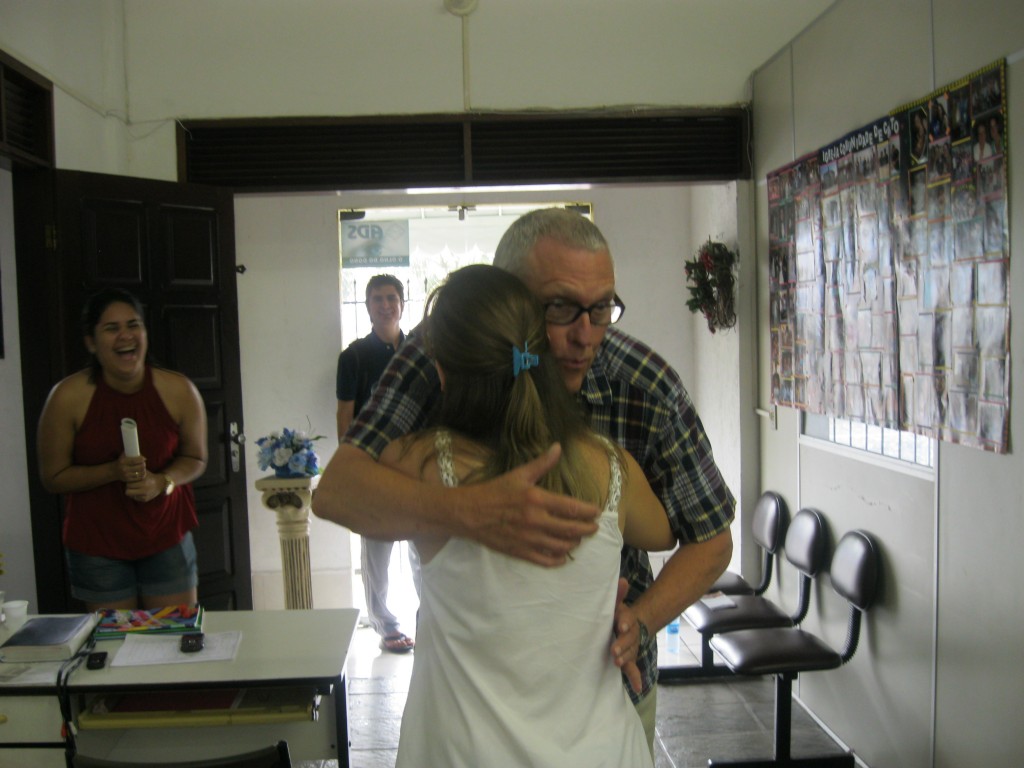
Fortunately, our host speaks both Portuguese and English fluently, and she gives me excellent advice on interpreting through the nonverbal. Greeting people, for example, with a handshake is OK, but the custom with men is also to pat on the shoulder, and with women to air kiss on each cheek.

Here in Natal we don’t eat food with our fingers. We must use a napkin, which is much smaller than ours in the United States, to hold a piece of bread, sweet roll, or sandwich.

When guests are leaving, in this case our readers, we show them to the door by walking with them and opening the door.

When eating in someone’s home or a restaurant, eat everything on your plate. Otherwise you have insulted the cook. Take small portions if you are not hungry or don’t care for the food, for you must eat it all.

Never eat in front of another person without offering him or her the opportunity to share the food.

These pieces of advice I am seeking to incorporate in my human relations, but I have to admit-I’m having trouble perfecting the air kiss.

Steve giving a Brazilian woman his “air kiss”

Have Fun with Words

I recently spent several days in London and Northern Ireland.  Even though English is the major language in both countries, many words have different meanings and some expressions, although they are words you know, have meanings that are different from in the United States.  For example, a pharmacist is a “dispensing chemist”, exit is a “way out,” and French fries are “chips.”  Trash is “rubbish,” a trunk of a car is a “boot,” an elevator is a “lift,” candy is “sweeties,” and athletic shoes are “trainers.”  And the list goes on and on. 

This experience made me think of some of the language challenges we have in our own country. For example, when I lived in Boone, North Carolina, mountain people had several different meanings for the word “poke.”   In that geographical region, poke was a type of greens you could fry and with proper seasoning make a tasty side dish.  A poke was a sack to carry your lunch in.  A poke was the front part of a sun bonnet that elderly women would wear.  Then there is the common meaning, as to poke someone with a stick. 

Here in Cincinnati, the word “please” means “I didn’t understand” or “Would you repeat what you said?”  In my home area of Southern Indiana, “please” was simply a proper way to ask a favor of someone. 

Don’t assume a word has only one meaning.  Engage others in a friendly discussion about the multiple meanings of certain words.  See how many meanings you can list for a particular word.  A good word to start this exercise might be “strike.”  Another is “fast.” What other words have multiple meanings? 

Listen, Ask, Listen Again

The words in the title of this piece are part of key training skills Delta Airlines is using to send 11,000 agents back to school, according to a recent article in the Wall Street JournalAnother  training skill  stressed is "be there."  This is another way of saying, pay attention to your customer!  Why are these skills being taught?  Because among major airlines this past year, Delta had the highest rate of customer complaints. 

            One of the points I stress in each listening seminar and in my keynote, “Be Present When You Are Present,” is the importance of listening and paying attention to the bottom line in any situation.  Many companies have similar products and cost.  The competitive edge, as Delta knows, is that customer service is based on these people skills of listening and attention.  On my website, I even offer wallet cards with reminders of “How to Keep Listening Instead of Talking.”

            If these skills are at the crux of profit and loss in a company, think how important listening and attention are in day-to-day living!  As Henry David Thoreau said, "The greatest compliment that was ever paid me was when one asked me what I thought and attended to my answer."