Using Humor in a Difficult Situation

As speakers, one of the challenges of speaking is having to speak to a sparse crowd. Just the visual aspects of seeing perhaps hundreds of empty seats and the audience sprinkled throughout the auditorium is demoralizing to both the speaker and the listeners. What can you do to turn this around to your advantage?

As a member of such an audience recently, I was impressed with how the speaker handled the small audience by using humor. Here are some of his one-liners that got us laughing and released the tension caused by the small crowd.

Within the first 30 seconds, he said, “Did all of you come on the same elevator?” He referred to us as a “cabaret crowd.” He finished his introduction of himself by saying, “This is great for me. I hate crowds.”

Once the crowd realized the empty seats did not faze him, they began to applaud. When this occurred, his response was, “Thank you. Those of you clapping, could you run around to room to give the effect of more people?”

Our speaker used humor to diffuse an awkward beginning to his speech. I’m sure he had these lines prepared just in case, and he was able to fit them in perfectly to bring the audience to him.

As speakers, one of the ways we can prepare for what may be the unexpected is to have some “ad libs” prepared whether it is for a sparse crowd, a squeaky microphone, or dessert being served as you start to speak.

The success of a speaker may depend not on great content (although that is always important), but on his or her ability to adapt to a difficult situation.
Fun With Words

A wall in our kitchen contains messed up similes I’ve said that my children have been accumulating for years. A few include, “Uncle Joe was a big cheese in a big pond.” And “You’ve got vision like a squirrel,” and the one that started the list, “He has a memory like a hawk.” I have a habit of playing with words in strange ways.

However, in a presentation this tendency can demand attention from your audience that will make your ideas more memorable.

A good source for fun words is greeting cards. Browse your local card store. One of my favorites is “I used to get lost in the shuffle. Now I just shuffle along with the lost.”

One of my wife’s favorites is “It will all be OK in the end.” And on the inside: “If it’s not OK, it’s not the end.”

Country music titles are enjoyable. Two of my favorites include “All My Exes Live in Texas,” sung by George Strait, and, “Does your chewing gum lose its flavor on the bedpost overnight?” written by Marty Bloom .

The title of my farewell speech when I left the university last spring was, “Meandering Thoughts of One Meandering Into the Sunset.” Look for fun word combinations by going to Vital Speeches of the Day and perusing the index for clever titles.

Personal dialogue is rich with humorous phrases and words. For example, my wife and I have been taking ballroom dancing lessons for many years and Greg has been our dance instructor for most of those years. A few months ago, I was having trouble learning a new step and getting frustrated.\r\n\r\nI said, “I’m not sure I’ll ever get this step!” \r\n\r\nGreg’s response: “Steve, you give me job security.” (Unfortunately true!)

The question and answer period at a press conference can be a place rich with light phrases and clever combinations of words. After a tough loss, Bill Fitch, a professional basketball coach for 25 years, responded to a question about communicating with his team: “I kept feeling like the Hindu snake charmer with a deaf cobra.”

Even service trucks on the highway can make you smile. As we were walking in Key West, Florida, this sign was on the back of a truck that passed us: “Plumbing to please in the Florida Keys.”

I’m not sure I agree with my family’s analysis of my similes. I see nothing wrong in saying, “Playing the clarinet is like trying to get music from banging a clothesline against a pole.”

Context and Humor

Using humor in a presentation is a challenge for most presenters. We are not comedians! Few of us can snap out the one-liners the way born comedians do. One way to make humor easier is to use the context of the speech.

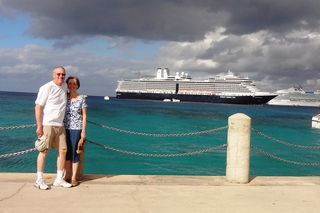
For example, a few days ago we were on a Caribbean cruise. Three of the days we were at sea and spent a lot of time on the ship engaged in all kinds of fun activities. The cruise entertainment director, J.C., was an especially good presenter. On the last day, as part of final instructions for disembarking, he talked about the great experiences on the cruise the past several days. Included were "questions" he had received during the week from some of the vacationers.Steve & Lanita & ship

With each question, the audience of several hundred laughed loudly. Questions he had been asked included, "Have you seen my husband?" Another was, "Does this elevator go to the front of the ship?"  The questions may seem not very funny on the surface, but one of the constant challenges for all 2000 guests was finding their way to different locations because the ship was so large. Getting lost was a possibility each time we left our cabins, so everyone could visualize getting lost.

Another question that brought howls of laughter was the question, "Does the crew sleep on board the ship?"  Much of the week had been spent hundreds of miles from shore so the thought of getting back to shore each night was hilarious. Similar to that was "Does the ship produce its own electricity?"

Probably the guest dialogue that got the biggest laugh was with an elderly lady who made this complaint to J.C: "There is no safe in my room." He kindly said, "Let me go with you to your room and show you the safe."  In the room, the safe was exactly where it was supposed to be. When he opened it, he found a cup of coffee and a Danish. Her response: "I wondered why the microwave did not work."  Context was the key since all of us had safes in our rooms and could visualize the vague resemblance to a microwave.

Developing humor without context can be challenging indeed. However, using context that everyone relates to will help you connect with the funny bone of the audience.