
Credibility That Commands Attention

Recently I had the good fortune to introduce Pat Day to an audience of professional speakers. This was truly a great experience for me because horseracing fans know that Pat Day is one of the greatest jockeys of all time. He has won the Kentucky Derby, the Preakness five times, and the Belmont three times. Until recently his $298 million in purse earnings was more than any jockey in the history of the sport.

Pat Day winning the 1992 Kentucky Derby on Lil E. Tee

I asked him what his topic was and he said that all of his talks center on Jesus Christ. After he retired in 2005, his main goal has been to convince people to become followers of Christ. Then he said, “I use my racing career as a platform for all of my speeches.”

That sentence in essence speaks to what every speaker wants: a platform from which to convince people of what you want them to do. How do we, the common everyday salesman, physician, clerk, lawyer, clergyperson, or teacher develop a platform from which we can command an audience’s attentiveness?

If you are a young speaker and just getting into your occupation, you have no work experience to draw from. If you have had a desk job for a long time, but nothing has happened that would really interest an audience, how do you have credibility that will demand attention?

One way is to use the platform of someone the audience respects. As a young professional, quote someone members of your audience admire. If you can quote from a personal interview you had with that person, that is even better. Refer to research that has impacted the audience in some way. In essence, if you have little credibility, borrow someone else’s!

Another way to gain a platform is simply the passage of time. As you grow older, grey hair and wrinkles give you credibility. Having taught in universities for several decades, I found that by the time I reached middle age, students seemed to gain more respect for me. I had many years of experience to draw from. When I first began to teach in my early twenties, I called each student by their last name, “Mr. Jones” and “Miss Smith.” This created a respectful atmosphere which enhanced my credibility. After teaching a few years, I found that approach was no longer necessary. My age was beginning to show.

Craft your words carefully. If you are able to speak an idea in an unforgettable manner, you win respect. You can tell by your audience response when you have used words well. They may take a note or nod their heads as if to say, “I hadn’t thought of it that way.”

For example, a line that came to me one day in talking about stage fright was, “The novice speaker is self-centered, and the experienced speaker is audience-centered.” That was a statement about how knowing your audience helps cope with anxiety in speaking.

You may never have been to the Kentucky Derby, let alone won the race, but all of you can develop a platform that will create the credibility you need to succeed as a speaker.
Creativity in Relating to Your Audience

What often separates the good speaker from the exceptional speaker is how he or she adapts to the audience. I’ve seen unique ways in which speakers have done this. One speaker took a photograph of the building the audience was in and used it to talk about how to determine the value of a building as a piece of real estate. Another speaker took several photographs of people during the social hour and used them to connect to some of the applications in her speech.

One of my favorite all-time examples, though, is from one of my students who wrote a class limerick for her final assignment of the semester. In this advanced public speaking course, we had listened to students give four speeches each over the l5 weeks. This young woman had taken careful notes in developing background on each person as he or she revealed personal information during the course of the semester. For her final speech, she gave an account of the class in rhyme. Here is an example.

As much time has come to pass,
I’ve learned a lot about those in this class.
They began to unravel—
Like we know not to travel
With Shelli, the European lass.

If for a good meal your stomach does churn,
For food, you’ll continue to yearn,
If Leslie or Brian cooks,
You’d better give them a book,
Or ask Stephanie since she did learn.

We know Casey is a good mother,
And Jennifer is an Elvis lover.
Vania’s accent’s not fake,
Kyle was lost in a lake,
And Beck B. tells jokes like no other.

And this pattern continued on throughout her presentation. She related to her audience because we were the heart and soul of the presentation.

Before speaking to a group of sales reps, I’ve found it helpful to ride with one of them to visit clients. Both conversation and observation help me to adapt to that audience.

Think about what special skills you have that would help you uniquely identify with the audience. This might be the key that helps you to compete successfully in the marketplace.

A Template for Repeated Presentations

Painting pictures with words is an important part of a speaker’s repertoire. Here is a variation that is good for the speaker who gives the same presentation in different cities. In this case, the speaker’s job is easier and the audience feels connected as the speaker paints the same kind of picture but with different scenes.

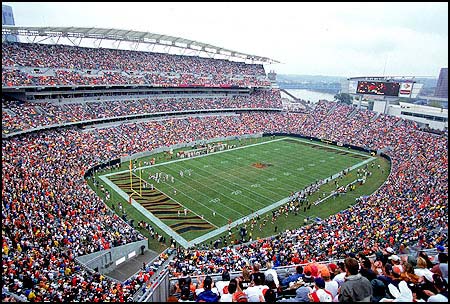
For example, a recent client of mine gives basically the same presentation regularly to different audiences. In the Cincinnati area, she begins by having the audience visualize the packed Paul Brown Stadium as the Bengals play on a fall Sunday afternoon.

You are among a crowd of 65,000 people. Picture them in your mind, cheering the home team on to victory. Now picture that same number of people as homeless in our Cincinnati/Northern Kentucky area. You see that is the number in our area who need our help.

She then goes on seek both volunteers and financial assistance from her audience members.

This same example could be given in most cities, substituting stadiums or other venues which seat a significant number of people in that locale. Do research to see what landmark buildings seat a number you can compare to the number of people who represent the need you want the audience to fill. You might be talking about the need for a new bridge that should be replaced before it is condemned by the state. You could mention a stadium or a combination of buildings nearby that seat the same number of people as cars that use the old bridge.

This technique gives you a unique beginning for the presentation that you deliver in different cities. It also gives you the opportunity of showing the audience that you have done your homework in relating to this audience and their city.

We usually think of a template in connection with PowerPoint, but this same pattern can be used in the actual content of your speech. It will make your preparation simpler and more directed to your audience.

What Kind of Conversation Was That?

You can tell how important something is by the number of words used to describe it. For example, according to anthropologist Franz Boaz, the Eskimo language has 50 words for “snow.” For most of us in the United States, snow is simply snow. But since so much of an Eskimo’s life centers on snow they have many words to identify it in various ways.

I believe the same is true of conversation in our culture. The variety of words for having a conversation stresses its importance in most of what we do each day.

For example, banter involves having a few quick, often witty comments with your listener, as does repartee. The quip might be a single comment in a conversation. Two people talking equally is a dialogue, while a heart-to-heart talk with someone close to you is a tête-à-tête. A slang term for a chat is a confab, short for confabulation.

When you have a conversation with someone who talks a lot but the content is superficial and disorganized, you might say this person prattles. Closely connected to that is to footle, which also means to talk foolishly. The raconteur is the person who tells stories in an amusing way.

One could mention many more examples. But this series of samples demonstrates that when you talk to someone you are doing much more than stringing words together to make a point.

What other examples would you add to this list?


Keeping Records of Your Presentations

If you are a serious speaker who addresses your department staff or your sales force on a regular basis you want to keep track of what you say so you don’t repeat yourself. Nothing is more embarrassing than telling a story that you told this audience six months—or six days!—ago.

My wife once went to a school in-service day, excited to hear last year’s speaker who had been so stimulating. She even took her previous notes to add to them. What a surprise when she heard exactly the same speech! She could see from her previous notes what story would come next. She was disillusioned as well as disappointed.

This was a constant challenge for me when I taught university students for many years and faced the same class 30 times a semester. To complicate this further, I often taught two sections of the same course. I had to remember which section I’d told a story to; conversely, I had to be aware of what I said in one class and make sure I said it in the other section. In addition, I preach each Sunday and have prepared and delivered over 3,000 sermons—most of those at the same church over the past 35 years. Although our church is a fairly transient group, some in my audience have been there every week for all those years.

At times I repeat the same material and don’t realize it. It is awkward for me when an audience member will come up to me after a lecture or sermon and tell that he or she heard me give that example before. But most of the time I avoid doing that and here is why.

The same day that I speak, or immediately after my classes, I go to my office and type a summary of what I covered in that class. I include any unusual questions or discussion. For many years I had a list of illustrations to accompany each lecture and I would check them off after I had used them.

With sermons, I have a hard copy of my notes that I file under the topic I discussed. For example, I have a file labeled “faith.” Any time I plan to preach on faith, I check the file to see how long ago I spoke on the topic. Since I have thorough notes on each lesson, I can generally recall content so that I don’t repeat myself.

In addition, I keep careful records of sermon title, date preached, and where I preached it. Thus I can look through that file and determine how long ago I spoke on that topic.

A significant factor that helps me avoid repeating material to the same audience is that I work hard to find new material to augment my content. I read both fiction and nonfiction. I find excellent human-interest stories in reading biographies as well as key current event articles I find online.

If you never speak to the same audience twice, then the above will probably not be useful. But if you have the same people in the audience time after time, these suggestions will help you approach the lectern with confidence that what you are about to say is new material to that audience.