Name-Dropping in Presentations

A friend of mine once hosted at the University of Cincinnati a special committee which included both business leaders and university people. After they assembled around the conference table, she turned to one gentleman and said, “I’m sorry, but I don’t know you. What is your name?”

Everyone froze.

With a gentle smile, he responded, “Neil Armstrong.” She had certainly “dropped” his name, but not in the way we usually think of. Not recognizing the first man to walk on the moon was embarrassing.

In speaking, name-dropping can add positive impact. Let’s examine how we should “drop” names in a speech.

First, mention the name of someone in your audience in the introduction of your speech. Before the speech, talk to enough people that you can refer to a person in the audience in a way that connects to you or your topic.

For example, I sometimes have in the audience a former student who now has a responsible job in the organization for which I am speaking. I will say, “___ was one of my students who majored in communication and now he is one of your managers. It is always great to see our graduates doing well.” Or “I met ____ earlier today and found out he too is a Hoosier and grew up in Southern Indiana as I did.” A specific reference to a person shows you have thought about and given attention to this specific audience. Such a reference helps establish your credibility.

A second way to drop a name is always to tell the name of the person who is responsible for a study you reference or a statistic you use. Stating the name connected with the study or statistic indicates you have done your research and also removes any pressure for you to be responsible for the statistic or study results. You are simply the reporter of the information to prove or illustrate a point.

Thirdly, quote a famous person. If the person is not readily familiar to them, you should also make a qualifying statement about the person. For example, I might say, “William James, an early American psychologist, said, ‘That which holds attention determines action.’” Or “Bill Gates said, ‘How you manage and use information will determine if you win or lose.’”

Adding a literary quotation of a famous person will provide quality to the language you use; mentioning the name will add depth to your content. One of my favorites is from Goethe: “One ought, every day at least, to hear a little song, read a good poem, see a fine picture, and, if it were possible, to speak a few reasonable words.”

When another person can say something better than you can, drop his or her name. For example, I like Thoreau’s statement, “The question is not what you look at, but what you see.”

The last way that “dropping names” can add to your presentation is to mention someone who can be a source for more information on the topic of your speech. For example, if I were talking about learning to pay attention in a world of distractions, I might mention Alan Alda’s Never Have Your Dog Stuffed (and Other Lessons I’ve Learned) or another author who has written an article or book on the subject. If I wanted the audience to take action, I might say the name of a person who will assist in taking specific action. Doing so gives reality to the content of your speech.

Dropping names in a speech can add depth and interest in your next speech. I’m thinking about talking to some of our current candidates about how they could use some of the tips in this and other newsletter articles.

This article, repeated here for its timeliness, was originally posted in August of 2007 by Stephen D. Boyd, Ph.D., CSP, Professor Emeritus of Speech Communication, College of Informatics, Northern Kentucky University, near Cincinnati. He presents keynotes and seminars to corporations and associations whose people want to speak and listen effectively. See additional articles and resources at www.sboyd.com. To book Steve, call 800-727-6520 or email him through his website.

The Hard Way-Usually the Best Way

I suggested to my adult son that he should exercise more.

His response: “Dad, I always take the stairs.” Good response, since that means he never takes the easy way to get to classrooms on several floors on Purdue’s campus.

When I was a young man, my coach gave me a leather basketball to play with during the summer. “Dribble it and shoot it as much as you can. You must make basketball a part of your daily routine if you want to improve for next season,” he said. He was telling me there is no easy way to improve.

This is a basic principle for most any worthwhile thing in life. This is especially important in delivering a speech. While coaching executives in presentation skills, I am amazed at how little time many actually take to prepare a speech. I’ll ask “How much time do you usually take in preparing for a presentation?”

The common response is, “Well, I have thought about it a lot, but I have been so busy.…”

It is hard to convince people that a bad speech can mean failure in securing a contract or project as well as affecting the reputation of the company in a negative way.

Here are tips on preparing the “hard way” for a successful speech.

Start early in preparation. Don’t procrastinate. Cramming might work for an exam, but not a presentation. Outline your speech carefully. Examine relationships among your main points to determine that the points relate to each other and to your main idea.

Be willing to revise and redo key words and phrases so that meaning is instantly clear and correctly develops the word picture you want to convey to your audience. Crafting the right words for that audience helps maintain interest and creates understanding in the audience’s minds. Read good literature to help you learn to do this.

For example, James Lee Burke in his most recent book, Creole Belle, describes the reaction of an audience to a preacher: “I had to hand it to him. As a speaker, Amidee was stunning. There was an iambic cadence in all his sentences. His diction and voice were as melodic as Walker Percy’s or Robert Penn Warren’s.” That is much more meaningful than “Amidee knew how to motivate an audience.”

Practice your entire presentation at least three times. However, with key stories and sentences, practice them as many times as you can. Speak them aloud as you drive to work or make sales calls.

Practice in front of a colleague or film a part or all of your speech and ask for feedback. Ask, “How can I improve? “

These techniques are not easy. To be effective, carefully craft your presentation—both content and delivery. With the “hard way” approach, your efforts will be rewarded.

The Two-Hour Lunch

The Two-Hour Lunch

In the United States, lunch is often a hurried trip to the vending machine, or the company cafeteria, or from a sack lunch you bring from home. Others make lunch a business appointment with a valued or prospective client.

In Natal, Brazil, the culture for lunch is much different. Two-hour lunches are a way of life there. Many stores close between noon and two. Ironically, at lunchtime one day when I wanted to buy bread at a neighborhood bakery, the store was closed. Even those businesses that depend on customers to buy their food close at what would be the busiest times at Panera or Subway.

Brazilian noon meal in Dr. Carlan’s home

I interviewed a successful dentist, Dr. Carlan, about the appointment schedule of the professional. A dentist for 33 years, he told me that he closes his office from noon to 2:00 and then works until 8:00 p.m. each day. When he was younger he would see patients even later than 8:00.

Lunch is the large meal of the day for Brazilians, and the meal at night is food that is light; soup is very common for the evening meal.

Our busiest times for reading appointments were what is the dinner hour for us in the United States: 6:00 to 8:00 p.m.

Conducting business for Americans in Natal would require adjustments in our eating habits. I have always had trouble keeping mentally alert after lunch. You can imagine what challenges I have with the two-hour main mealtime of the day.

The Brazilian approach to lunch would give more credence to Adele Davis’s words, “Eat breakfast like a king, lunch like a prince, and dinner like a pauper.”

Winter in Natal

I do not like winter! I don’t like waking up on a January morning when the temperature is below zero and six inches of snow are on the ground. The forecast is very cold and a threat of more snow.

Winter in Natal, Brazil, in July was not so bad. When I awakened in the morning, the windows were open, I felt a cool breeze, and the temperature was in the low sixties. The trees with green leaves were interspersed between palm trees and a variety of exotic flowers.

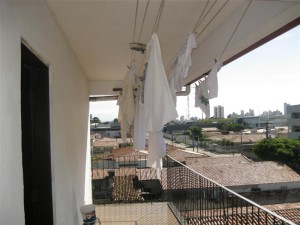
I knew that was the rainy season there; if the sun was shining, I realized that in 20 minutes it could be raining. That did not bother me because an hour after the rain stopped, the sun was shining again. We hung our clothes on the line outside our apartment door and they were dry in just a few hours.

The high temperature was not eight degrees, but the low eighties. For lunch we walked to the portable restaurant a block up the street for a freshly grilled chicken and walked a few yards more for a Coke and fruit at the neighborhood market.

Instead of putting on boots, I had to decide whether I wanted to wear sandals or Dockers with no socks. I’m not sure anyone there owns a pair of gloves. Our big concern was whether we should take an umbrella with us.

I have to admit I looked forward to DQ and grocery stores without lines. But no more can I say I hate winter—at least not in Natal.

Prove It

If you go to a medical facility for treatment, you had better have your birth date—day, month, and year—on the tip of your tongue because you will be asked to repeat that date by each person who assists you.

When you have to provide a password for the first time, you must repeat it on the next line.

When you fly, you had better not lose your boarding pass because you will show it to the person checking your identification getting through security and show it again as you board the plane. If you are flying internationally, you may be required to show the boarding pass several times more.

Years ago, simply telling your name or showing your driver’s license was about all you needed to make a trip, purchase an item, or go the doctor. No more.

Trust is a precious commodity, and because people continue to abuse that precious asset, we have to prove who we are with various kinds of evidence.

Because of this trend, as speakers it is even more important that we do what we can to develop trust from our audiences. Somewhere in the early part of your presentation, you should build credibility in a way that earns the trust of your audience. Here are some ways to do that.

Show your personal concern for the group by referring to a project they are involved with, or mention an organization that many in the group contribute their time or money to. Perhaps you can mention your connection with a person in the audience that you know all respect.

In a way that is not bragging, mention your expertise as you give a piece of evidence or a case study to make a point. For example, since I deliver an after-dinner speech that includes auctions, I might say, “I remember as a teenager, watching my uncle crying an auction; I would later practice the chant in the privacy of a hayfield.” Later in the speech I actually conduct a short, entertaining auction.

Before speaking, do your homework and check all sources for data you may provide. Perhaps call a source to verify a quotation or statistic. Keep careful records on sources.

You can buy about anything but trust. It isn’t as simple as repeating something once or twice, as in birth dates or passwords. You earn trust. As Edward R. Murrow once said, “To be persuasive we must be believable; to be believable we must be credible; to be credible we must be truthful.”

Stephen D. Boyd, Ph.D., CSP, is Professor Emeritus of Speech Communication, College of Informatics, Northern Kentucky University, near Cincinnati. He presents keynotes and seminars to corporations and associations whose people want to speak and listen effectively. See additional articles and resources at www.sboyd.com. To book Steve, call 800-727-6520 or email him through his website.