Let’s Have a Bonfire!

I always thought of bonfires as a way to celebrate an important victory in sports or as a campfire for roasting hot dogs and making S’mores. I did not know that the bonfire is also believed to keep evil spirits away.

On our way back to our apartment in Natal a few days ago, we saw bonfire after bonfire along the road among small communities as we drove a 20-mile stretch of highway. No one seemed to be attending the fires and no one was standing by the fires roasting hotdogs or creating S’mores over the hot flames. I kept thinking what a fire hazard each unattended glowing fire was.

We quickly began counting and saw over 400 bonfires during our drive back, many in Natal. We could not imagine why there were so many fires.

We did some checking with Brazilian friends and found out this night was the eve of St John the Baptist Day in Brazil. On this night each family builds a bonfire to ward off evil spirits—or simply as a tradition.

This experience demonstrated again that meaning is in people. A bonfire now has a new meaning for me to go along with celebrating activities and having a good time eating special “junk food” under the stars.

From now on I will probably think of the evil spirit meaning first and other more common uses of the bonfire second. Who knows? Maybe in all of my experiences with bonfires, I unknowingly was getting rid of evil spirits!
 

Check Your Attitude

One of the keys to effective communication is to exude a positive attitude as you deal with people. That is not always easy. You burn your tongue drinking too hot McDonald’s coffee. You sit for 30 minutes on the interstate because of roadwork. Not conducive to a positive attitude!

Think about daily life in other countries. In Brazil where we are two weeks into a mission project, I have already learned to appreciate the blessings of living in the United States. When discussing the meaning of “robbed” with a 20-year-old student, I wanted to see if he understood the meaning in context. I asked him, “Have you ever been robbed?”

His answer was, “Yes, seven times. It is common where I live.”

The same young man came to our reading session on a motorcycle and made the statement, “This is the only kind of transportation besides a bus that I can afford. It is very dangerous. People do not obey the laws of driving and pay little attention to people on motorcycles.”

In the USA, drinking water is available at any water fountain, but in Brazil you drink only bottled water. Water from faucets and showers is not safe: don’t drink it.

At home, we sometimes get frustrated when we have to wait in line at a grocery store. At our visit to a local grocery store last week, we waited in line 50 minutes.

The people of Brazil are very friendly and helpful and they don’t complain at all about the inconveniences I mentioned above. I see how spoiled I am, living in the United States all of my life. When I get back to the States, I trust I can check my attitude with this reminder of what life is all about for many people in other parts of the world.


Eating and Greeting: Living in Natal

As we continue our mission project in Natal, Brazil, I’m reminded of the power of the nonverbal. Since I don’t know Portuguese, and many of the people of Natal do not know my language, I rely on the non-verbal.

Fortunately, our host speaks both Portuguese and English fluently, and she gives me excellent advice on interpreting through the nonverbal. Greeting people, for example, with a handshake is OK, but the custom with men is also to pat on the shoulder, and with women to air kiss on each cheek.

Here in Natal we don’t eat food with our fingers. We must use a napkin, which is much smaller than ours in the United States, to hold a piece of bread, sweet roll, or sandwich.

When guests are leaving, in this case our readers, we show them to the door by walking with them and opening the door.

When eating in someone’s home or a restaurant, eat everything on your plate. Otherwise you have insulted the cook. Take small portions if you are not hungry or don’t care for the food, for you must eat it all.

Never eat in front of another person without offering him or her the opportunity to share the food.

These pieces of advice I am seeking to incorporate in my human relations, but I have to admit-I’m having trouble perfecting the air kiss.

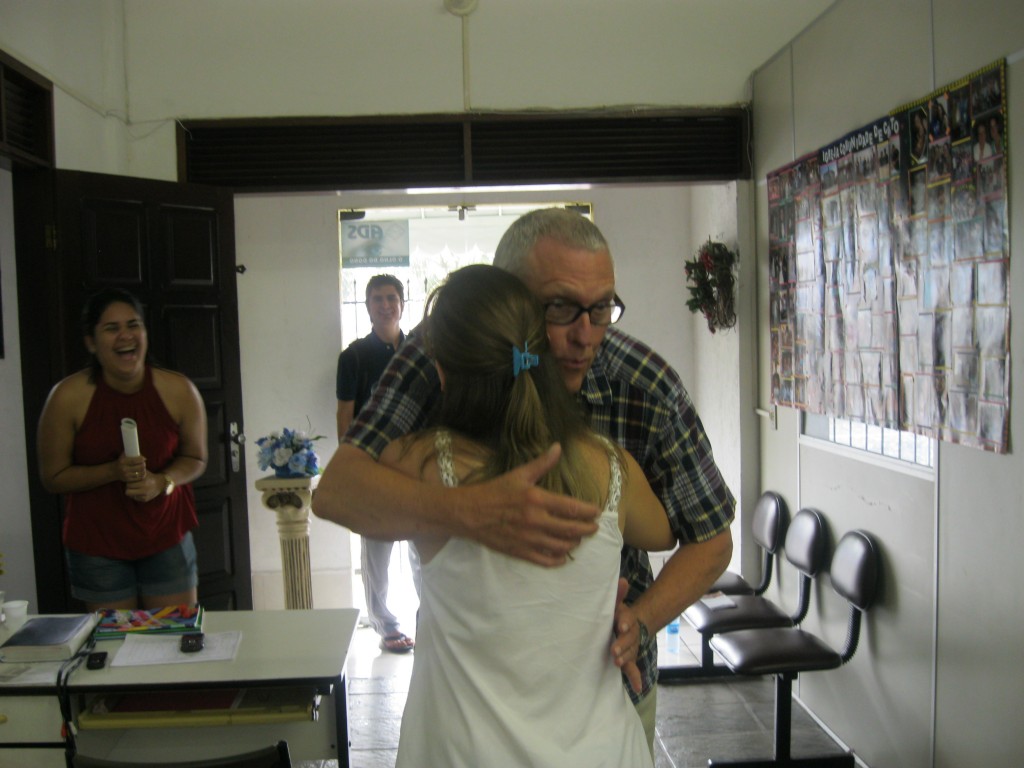
Steve giving a Brazilian woman his “air kiss”

Tied to Surroundings?

When I was a young person, playing basketball was definitely a priority over studying . Every spare moment I was in the back yard shooting or in the gym practicing basketball. It wasn’t until I did not make a college basketball team that I finally understood the value of spending more time in the library than I did in gymnasiums.

I kept going to school and spending time in libraries through my undergraduate program and five years of graduate school. Much of that time was spent in the stacks and main reading room of the library at the University of Illinois.

Fast forward 42 years later to my retirement from a career in college teaching. I now have the opportunity to choose how I spend my time.

To my surprise, I am drawn again to the library! This, however, is no ordinary library. The Mercantile Library in downtown Cincinnati offers the privilege to step back into time—back before technology allows both faculty and students to have the resources of a library at their fingertips. This library is so similar to the one at Illinois. Everything is wood: beautiful wood paneling, shining wooden floors, sturdy wooden tables, and cushioned wooden chairs. I sit among sculptured heads of Mark Twain and Charles Dickens as well as shelf after shelf of well-worn books. Wi-fi is available, but there is also the card catalogue to peruse. The stacks are open to members. We pay $55 per year to use all their resources. It has become my office at least one day a week when I am in town.

Last week as I sat pondering a speech I was preparing, I observed the beauty, comfort, and quietness of the library. I could not help but think about how after all these years I am drawn again to this setting, once mandatory, and now my choice.

We all learn to adapt to required surroundings, sometimes even grudgingly. Then what a surprise when those very situations are what we turn to when given a choice!

Helping People Remember Your Speech

We want our audience members to remember the point of each speech. To make it easier for the listener to retain information, we must speak our key ideas in different ways so that listeners will take our ideas with them.

Preview your ideas. In the introduction, tell the audience what your two or three major ideas will be. Not only will this begin the process for the audience to remember ideas, but also it will get their attention since you are giving them specific directions on what you want them to consider.

Internal summary is another way to remind the audience of your ideas. In the middle of your speech, you summarize. “Now that we have talked about the importance of the preview, let us move on to the use of internal summary” would be an example. In addition, the internal summary allows you smooth movement from one point to another and will keep you from using the verbalized pause as a transition.

A change of pace is to give an idea special attention. Suggestions are, “Be sure to put a star by this point,” or, “You may forget other things I say, but remember this point.” Only do this once or twice in your speech, but in this way you can give key thoughts billboard position.

Don’t forget the value of supporting a point with an example. You are tying the point to a story which reinforces the idea for the listener. People tend to remember what you say after you begin with, “Let me give you an example of that point.”

Finally, include a question and answer period at the end of your presentation. In answering questions, you reinforce key ideas or you are able to give more illustrative material to instill a thought in the minds of the listeners. You might answer a question with, “As I mentioned earlier…” and then say the point with a different piece of support.

Oscar Wilde said, “Memory is the diary we all carry with us.” Use these techniques to encourage each listener to enlarge his or her “memory diary.”

Let’s Give It Up for Dad!

We are in the time of year when Americans celebrate special people and special days. A few weeks ago it was Mother’s Day, then Memorial Day. Coming up we have Father’s Day and the Fourth of July.

A part of any of these celebrations can be a toast. A toast is simply an affirmation in words of a person or an event. A toast has several simple guidelines.

Make sure ahead of time that every one has the appropriate toasting materials-a glass, cup, or goblet-and that it contains the appropriate liquid, whether champagne, iced tea, or water.

Here are some tips for a successful toast:

  • Keep it under two minutes in length.
  • Begin with the purpose of the toast.
  • Say something specific that affirms the person or event.
  • If possible, include a relevant quotation.
  • Finish with a version of “so we toast you today, Dad.” At the same time raise your glass to let people know they are to do the same.

In general, I don’t recommend a manuscript for most speeches, but the toast Is one where a script works well. You are less likely to get emotional because you are concentrating on the words and your words will be more carefully spoken.

So let’s say we are toasting Dad, celebrating Father’s Day. Do not do this without proper preparation. It’s apparent the toast is going to be awkward when the toaster begins with, “There are so many things I could say about this man.” Or “I don’t know where to begin.” Avoid those kinds of beginnings by starting with “We are here to toast Dad on his special day.”

Although my father is deceased (if the person is deceased we call the affirmation with words a eulogy!), if he were alive this might be my affirmation:

“Dad, you truly are dedicated to your children; you never missed any of our ballgames, you drove us to piano lessons, you waited on us when we were sick, and you always had time to listen to us, and yet you never complained.

“Charles Wadsworth said, ‘By the time a man realizes maybe his father was right, he usually has a son who thinks he’s wrong.’ I hope you realize, Dad, that we always appreciate you as someone who is not wrong, but is instead one who is wise and serves as an excellent role model for all of us.”

The final line might be simply, “For all of these traits we salute you, Dad.”

When Father’s Day comes, take him to his favorite restaurant or cook his favorite food. Make the activities all about him, and a highlight of the day will be your customized and carefully prepared toast.

Stephen D. Boyd, Ph.D., CSP, presents keynotes and seminars to corporations and associations whose people want to speak and listen effectively. See additional articles and resources at www.sboyd.com. To book Steve, call 800-727-6520 or reply to this email.

Speaking From the Overflow

A question I’m often asked about preparing a speech is, “How do I know when I am ready to speak?” One way of determining your readiness is when you realize that you have more information than you can ever cover in the time allotted. A powerful presentation is one that comes from the overflow.

If you say to yourself, “I hope I have enough material to take up the time I have to speak,” then you are not ready to speak. Granted, it is a challenge to find an abundance of information—especially if you have not delivered many speeches.

However, when you have to eliminate rather than stretch your material to cover the time, you are likely to have left only the most powerful examples, statistics, and testimony to prove your points, strengthening your content. Here are suggestions to make that happen.

First, incorporate a variety of sources in researching your subject. The more different sources you have, the more possibilities for materials to use in the presentation. For example, if you have an article from a trade journal, a quotation from a newspaper clipping, an interview with an authority, and a personal narrative on the topic, you probably have more material on a single point than you can use; you will have to choose only one or two pieces of evidence. This scenario usually ensures a rich and powerful piece of evidence for that part of the presentation.

Two, avoid “cramming” for a presentation. Start early in preparing the presentation. Much of the inspiration for a speech comes from merely mulling it over. Just thinking about the presentation while driving to and from work will give you a range of ideas that escape you when you are pressed for time and wait until a few hours before the speech to prepare. Audiences can sense when you have lived with a topic for a while—it shows in the depth of your thinking.

Third, talk to other people about your topic in the days and weeks before you present. Try out one of your ideas as dinner conversation with a small group of associates or family members. Just going over the idea aloud will often give you information from your own thinking or feedback from the people with whom you share your ideas. This gives you a time to practice informally, and with each practice time you can add significant details.

Finally, make all of your reading and listening experiences a time of preparation. If you always have your mind open to materials connected to the areas you speak about, you will be more likely to pick up new and creative material for your next speech. For example, a recent article on the anniversary of the Golden Gate Bridge reminded me of earlier material I had saved about the bridge that I had used in a speech several years ago. I began thinking how I might tie in the 75th anniversary of the opening of the bridge with an upcoming presentation.

Audiences know when you are speaking from the overflow. It shows in your confidence and in the depth of your material. Freshwater springs are often surrounded by plant and animal life because springs provide an environment for growth. A presentation which springs from the overflow of the speaker’s preparation provides the same environment of growth for listeners and is not soon forgotten.

Arriving in Style

I spoke in Charlottesville, Virginia, a few years ago, checking into a hotel about two hours before my speaking engagement. Since I needed to be at the engagement by 6:30 and it was a 15-minute ride, I requested a cab for 5:30, allowing myself plenty of time.

After freshening up, I returned to the lobby. No cab.

The hotel clerk told me that the cab would arrive at 6:00. I was a little anxious by this time and started pacing. Six o’clock came and the cab did not. I was getting desperate.

I asked the clerk if I could hire one of the staff to take me. He said, “The van just left for the airport and there is no one here now but me.”

I looked up and down the hall to find anyone I could grab and plead for a ride. No one.

Then the young man behind the desk—clearly a problem-solver—simply handed over his keys and said, “Take my car. I won’t be going anyplace until 11:00.”

I said, “Are you serious? You don’t know anything about me.”

He said, “You need a ride, and I have a car—take it!” Then he told me the model of the car—a rather old Mazda. He said, “Now the radio is on loud, so you’ll want to turn it off.”

I ran to the parking lot. When I found the car, I also found he had the seat so far back I could almost lie down as I drove. I literally vibrated to the loud sound of rap music as I drove out of the parking lot. I didn’t even bother trying to lower the volume as I sped off. Well, as much as you can speed off in a 1979 Mazda. You might say I “ambled” off. I made it to my speaking engagement with less than five minutes to spare.

When I got back to the hotel at 10:00, the young man did not want any money, although I insisted on a nice tip. What he was most interested in was how well my speech went. And I told him it went great because of him.

I probably learned more than my audience did that night because of this young man. He taught me the value of helping someone in need, without reservations. I could tell for him this was no big deal. A man needed a ride and he supplied it. I hope I, too, can be that spontaneously responsive to those with unusual needs.