
Presence and Presenting

            This past week-end the Cincinnati Reds Caravan made its way to Bowling Green, Kentucky, for an appearance. Hall of Fame broadcaster for the Reds, Marty Brennaman, and several Reds players and front office staff made the trip. The caravan is divided into three separate tours making a total of l5 fan stops in four states, covering more than 2,700 miles in four days.

            Why would money and time be devoted to such an event? Why not have a special television program and have different Reds celebrities appear and be interviewed? A main reason is that people want to see those who broadcast their favorite baseball team and meet some of the players they follow daily during the six-month season. Who knows how many tickets are sold to Reds games because the fan now feels a personal connection with the player? No doubt many will listen to a Reds game on radio or watch on television because they have seen in person the announcer or players.

            Sometimes the message of the speaker is not as important as the speaker. We want to see our CEO speak at our company's year-end meeting and we want to hear our minister or priest present at important religious events. We want our leaders who represent us to show up at town meetings and interviews.

            Don't allow your technology to substitute for the person. Important messages should be communicated in person. When a loved one has surgery, we don't want to receive a text message saying our spouse or child did fine through the operation. We want the surgeon to come out to the waiting area and talk to us face-to-face. We will not fire a person by phone, text, or email (I hope!). Watching the nonverbal and getting a sense of the emotional interaction is too important not to include in the message.

            When you have a choice of sending a message or talking to the person, or when you can send out a long memo to the company or appear in person to present the message, don't just consider the content of the message. Your presence may be more important than whatever your message might be.

            When a company has a United Way kick-off meeting, for example, it is vitally important that the CEO be present to speak.  What he or she says is not as important as just showing up. This tells the employees that this endeavor to raise money for community projects is really important to this organization.

            Technology seems to take much of our communication time. But as long as there are people, there is a place for presenting the message in person. Baseball season is still a few weeks away, but fans are buying tickets and anticipating a winning season because their favorite Red came to talk to them.

Stephen D. Boyd, Ph.D., CSP, is Professor Emeritus of Speech Communication, College of Informatics, Northern Kentucky University, near Cincinnati. He presents keynotes and seminars to corporations and associations whose people want to speak and listen effectively. See additional articles and resources at www.sboyd.com. To book Steve, call 800-727-6520 or email him through his website.
 

Clarity in One Sentence

One of the major challenges for the presenter is making the message instantly clear. Audiences cannot click “back” or "rewind" and hear again what you just said. The audience member cannot say, "Hold on while I look up the meaning of that word," or "Give me a few minutes to get some background information online.” Your language choice must be instantly clear.

The most effective way to combat this challenge of immediate clarity is to use a comparison where you connect the familiar with the unfamiliar. I'm reading a book about World War II, Unbroken, by Laura Hillenbrand. In the book she discusses how difficult it was for a pilot to fly a B-24 bomber because of the way it was constructed and the bulkiness of fuel tanks needed in order to fly l6 hours without landing. To give the reader a clear understanding of how difficult this was and why pilots disliked flying this plane, she quoted one pilot who said, "It was like sitting on the front porch and flying the house!"  You may never have been in a bomber or have any inkling about flying planes of that generation, but with this one sentence you understood how awkward and challenging this plane was to pilot.

The comparison can sometimes be a piece of humor as well as making a point clear. For example, you may not know much about defense configurations in basketball, but consider this comparison by one of the most successful NBA coaches, Norm Sloan. In talking about a zone defense he said, "It hate it. It looks like a stickup at 7-Eleven. Five guys standing there with their hands in the air." 

Such comparisons can make a world of difference in audience interest in what you have to say.


Find It in an Obituary!

Great sources for new material in your next presentation can come from unusual places-such as obituaries!

I’ve always sought to find in nonfiction books original or creative stories or information that I might adapt to a particular speech, but my wife introduced me to the obituary as an additional source. She shared with me an unusual obituary she found in our local newspaper. The account was short, regarding the life of an 89-year-old lady from Covington, Kentucky. The statement that took my breath away was this: “Survived by many, remembered by few.” 

One can’t help but speculate on how this sad commentary came to be included in the obit. Perhaps the woman had requested the line before she died. Or maybe one of the few who did remember wanted to remind those who knew her that they had pretty much ignored her in life. Whatever the source, this piece of nonfiction could be applied to several components of human relations, including the importance of giving attention to our senior relatives and friends.

Audience members are attracted to material they have not heard before, and this is tough considering the ease of finding information on the Internet. To keep your material fresh, seek out unusual sources for material besides the usual sources such as biographies. Think of what intrigues you and might interest others.

Strolling through a cemetery has given me ideas for illustrations, including epitaphs on tombstones or drawings, such as a page from a hymnal, carved into the stone. Recently we found Bud Light Cans on each side of a gravestone.  One can only speculate on the significance of those.

Guides on tours of significant landmarks provide captivating lectures to share. As we passed through a small town in Alaska, the guide informed us that law enforcement agents used to check out the town occasionally because the place was so removed from civilization. When satellite television reception arrived there, several arrests were made in response to “America’s Most Wanted.”

Pick up a brochure when you visit a landmark. I learned much about Kentucky Bourbon from brochures while touring the Bourbon Trail in central Kentucky. When chatting with older people, ask what their childhood was like.

Seek information about a topic when you meet an expert on a given subject.  I learned much about coffee beans in talking to a key executive in charge of purchasing coffee for a large manufacturing company. Keep a pen and paper close by when you are watching a movie. Dialogue from the movie sometimes has great quotations you can use in a speech. For example, in the 1992 movie, A League of Their Own, Tom Hanks, as manager of the team says, “It’s supposed to be hard. If it weren’t hard, everyone would do it. It’s the hard that makes it great.”  I’ve used this quote for years.    

Another classic quotation I still use was from a homeless man I met in the Bowery of New York City. I told him where I was from and that we were sightseeing.  His response: “Ten years ago I came to see the sights, and now I am one of the sights.” 

Don’t limit your sources for thought-provoking information for your next presentation. You may find a memorable line in a simple conversation—or in an obituary.


Context and Humor

Using humor in a presentation is a challenge for most presenters. We are not comedians! Few of us can snap out the one-liners the way born comedians do. One way to make humor easier is to use the context of the speech.

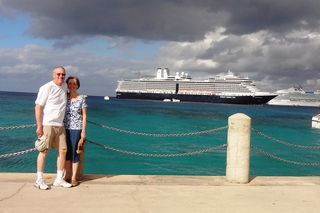
For example, a few days ago we were on a Caribbean cruise. Three of the days we were at sea and spent a lot of time on the ship engaged in all kinds of fun activities. The cruise entertainment director, J.C., was an especially good presenter. On the last day, as part of final instructions for disembarking, he talked about the great experiences on the cruise the past several days. Included were "questions" he had received during the week from some of the vacationers.Steve & Lanita & ship

With each question, the audience of several hundred laughed loudly. Questions he had been asked included, "Have you seen my husband?" Another was, "Does this elevator go to the front of the ship?"  The questions may seem not very funny on the surface, but one of the constant challenges for all 2000 guests was finding their way to different locations because the ship was so large. Getting lost was a possibility each time we left our cabins, so everyone could visualize getting lost.

Another question that brought howls of laughter was the question, "Does the crew sleep on board the ship?"  Much of the week had been spent hundreds of miles from shore so the thought of getting back to shore each night was hilarious. Similar to that was "Does the ship produce its own electricity?"

Probably the guest dialogue that got the biggest laugh was with an elderly lady who made this complaint to J.C: "There is no safe in my room." He kindly said, "Let me go with you to your room and show you the safe."  In the room, the safe was exactly where it was supposed to be. When he opened it, he found a cup of coffee and a Danish. Her response: "I wondered why the microwave did not work."  Context was the key since all of us had safes in our rooms and could visualize the vague resemblance to a microwave.

Developing humor without context can be challenging indeed. However, using context that everyone relates to will help you connect with the funny bone of the audience.

Have a Hook!

Most business speakers who represent their companies as they speak to clients do not have ambitions to become motivational speakers. You, however, can learn to improve your own business presentations by learning from successful motivational speakers. A key to be effective in your career presentations is to have a “hook.”  Paid motivational speakers often have some unique challenge that they have overcome, so they use that event as a "hook" to share success ideas in their speeches.

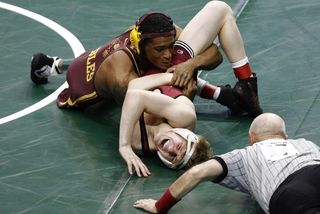
For example, in March of this year Anthony Robles won the 125-pound NCAA Division I championship in wrestling. The unusual feature of this feat is that he has only one leg. According to Jason Gay in a Wall Street Journal article, "An Inspiration Moves Off the Mat," Anthony has not been home often since his victory because he has been on the road most of 2011, "…building a profession as a motivational speaker. He's spoken to companies, schools, halfway houses and pro teams."  In his speech he tells his personal story of being born to Judy Robles, a 16-year-old mother who raised her son "…telling him he could do anything, and watched him go out and prove it." Anthony Robles


We all have had unique experiences in life that have brought us to our places in our careers. Think about obstacles you overcame, or an event that changed your life forever. Perhaps you had an unusual job at one point that might dovetail into the content of your presentations. I grew up in an auctioneer family and learned to deliver the auctioneer's chant at age 14. I worked as my uncle's assistant until I left for college. I sometimes incorporate the chant in a speech—especially in the introduction.

When I was a boy, my dad and I had one of the largest rabbit farms in Indiana with over 350 in our rabbitry. That is an effective hook I use to talk about different ways to multiply your investments of time or money.

Think about unique life experiences that might make you stand out from other speakers vying for a business contract from a prospective client. Perhaps you need a special way to keep the interest of your employees as you explain a new benefit package or a new software program you are initiating. What is there about your background that might work toward that end? 

In basketball, the hook shot is common for a tall person to shoot within ten feet of the basket; the main reason is how hard it is for the defensive player to block it even when he or she knows the player is about  to shoot a hook. In like manner, a hook in your next speech will demand the attention of the audience even if they don't want to listen. Whether in fishing, basketball, or a presentation, the hook is indispensable.