Think Ahead!

            To be successful in delivering a presentation or in life, always think ahead. When giving a speech, think ahead about your audience. Find out as much as you can about the people in the audience. Talk to speakers who have addressed the group at previous meetings. Get to the meeting room early and check out your equipment, the room temperature, the lighting, and unique factors, such as an L-shaped room which might keep you from seeing all of your audience.

            Lanita's Uncle Tommy retired after 35 years of driving semis over 2 million miles without an accident. When I asked him about the most important aspect of safe driving, his answer was, "Always look down the road for brake lights."  This was another way of saying, "Think ahead." 

            To eat right, instead of stopping at the nearest fast food place on your way to a meeting, before leaving in the morning check the refrigerator for the makings of a salad you might take with you for lunch. Grab a container of yogurt and some nuts. You will eat better and feel better as the day progresses.

            Before making that important phone call, make a few notes on what you need to cover. At the beginning of the week, make a "date" for a week-end excursion with family. Make reservations a couple of days before you plan to go to your favorite restaurant. Check the calendar at the beginning of the month for birthdays of friends and family that you want to remember with a card or a call. Think before you speak.

            Don't pay attention only to what is at hand, but think ahead to the rest of the day and how to make the best use of your time and talents. Or in the words of Ed Helms, "I'm always thinking one step ahead — like a carpenter that makes stairs."

Don’t Miss the Good Stuff!

Last week I heard speaker Scott McKain who stressed an idea about life in general: "Don't miss the good stuff." I also stress the importance of that idea about the opening of a presentation. I tell my presentation skills workshop participants to begin their next speech with "good stuff."  Beginning with an idea, quotation, or story that grabs the attention of the audience jumpstarts a successful presentation.

I also agree with Scott about life:   don't miss the "good stuff" around you. For me recently that has been watching six men’s NCAA tournament games in Chicago's United Center last weekend with my son. This regional men's Division I tournament was our eighteenth together, and we have seen 94 different teams in that period of time. (Not that I’m a numbers person, but Josh keeps track of them.) He and I also devoured some of the best tournament food—brats, barbecue, popcorn, hot pretzels, and ice cream in a waffle cone, just to mention a few. We justify all this "health" food by saying we only do this once a year.

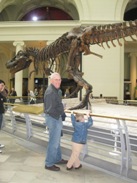
Whatever city we are in, we take in the sights, from pier food in Jacksonville, Florida, to hiking in the Smokies when the games were in Knoxville. This past week-end we toured the Field Museum and the Museum of Science and Industry. The bonus this year was that our wives and my grandchildren joined us on Saturday and Sunday afternoon when there were no games.Sue, Steve, & Knox

This is "good stuff" for me. But other "good stuff" is the first daffodil popping up out of the ground and the grass going almost overnight from brown to green as spring begins to show its mighty colors.

Whether in a speech or in life, pay attention to the "good stuff." What is “good stuff” in your life? I welcome your comments.


Prefer a Firing Squad?

          This title is hyperbole, but many people say they would prefer any task to delivering a speech. Three basic fears involve what people think, failure, and the unknown. Presenting a speech may be daunting because it includes all three fears. Consequences of stagefright can even include physical illness. Earl Nightingale made this point vividly. He said this about giving a speech: “You may feel like you are in the terminal stages of some type of tropical fever."

          Probably the most frequently asked question of me when training or coaching presentation skills is "How do you deal with stagefright?"  The key is not to eliminate these fears, but to control them. Here are a couple of methods.

          Practice aloud. I'm not talking about closing the door to your office and pulling out your notes and pondering what you plan to say. That part is important, but to conquer your fears, actually practice what you plan to say. A talented basketball player can't just think about hitting free throws; he or she must shoot foul shots over and over to have the disciplined calm needed to hit two foul shots when the game is on the line. To be in control when speaking to an audience of l0 or 1000, practicing aloud is crucial. This practice helps control the unknown; you know how long you take for your presentation because you timed the speech. You will have less fear of failure because you have successfully gotten through the speech in practice sessions.

          How many times should you practice?  My comfort level is three times. Going over the material aloud three times gives me opportunities to tighten up structure as well as helping me feel comfortable with the pacing and nonverbal aspects. Any more frequently than three times I am in danger of getting tired of the material before I face my audience.

            Arrive early. A second method to control stage fright is to arrive early to check all variables surrounding your speech. Rushing to get to the speaking room is discombobulating, whether it is down the hall or across town or on the other side of the country. Plan to arrive early to check the room where you will be speaking. Check the physical aspects including sound, temperature, configuration of the room, number of seats, and lighting. Sit in the back of the room to see what the audience sees at the greatest distance from the speaker. Do a sound check. If you are using visuals, try out the technology support you need. Walk around the room and become familiar with the space and feel of the room. Talk to the people who arrive early. All of these will relax you and help you feel comfortable with your surroundings. You will be less tense and more at ease because you don't have to worry about getting to the engagement on time and dealing with any unexpected variables.

          Was this helpful to you? In addition, I have a great offer for you! For the next 48 hours, everyone who orders my book, ATTENTION! The Art of Holding Your Audience in the Palm of Your Hand, will receive immediately my BONUS PDF article, “Ten Tips on Controlling Stage Fright,” including # 6, Why you need to incorporate movement early in your presentation. You will learn other valuable techniques on handling this most important challenge in presentation skills. Call us at 800.727.6520 or email us right away. We can bill you through PayPal and you can start today getting control of your stagefright.


Stephen D. Boyd, Ph.D., CSP, is Professor of Speech Communication, College of Informatics, Northern Kentucky University, near Cincinnati. He presents keynotes and seminars to corporations and associations whose people want to speak and listen effectively. Visit his site to read other valuable articles on effective speaking and listening or call him at 800.727.6520.
Teaming for Success

Today we have a guest author, speaker and consultant Joan Fox, CSP, who specializes in customer service. Her ideas on teamwork are so good you may want to forward them to everyone in your organization!

“We are born for cooperation, as are the feet, the hands, the eyelids, and the upper and lower jaws.”             
                              
 Marcus Aurelius 

One single fact trumps all others when it comes to the ability to deliver an exceptional client experience. Simply put, we cannot give what we do not have. It is impossible to make clients feel served if the internal culture is not one of respect, trust, open communication, support, and accountability. In other words, a team-based culture where people are truly working together is most likely to achieve an exceptional client experience.

Team is a word thrown around and discussed as if it were common and easy. The opposite is true. Most organizations run as a series of departments (which operate like compartments), committees, and isolated entities. Within each of these, there is a hierarchy of power and responsibility, blaming behaviors when things don’t get done, and a tendency to self-preserve. It is no wonder large organizations consistently struggle in delivering exceptional patient experiences.

But it can be done. Let’s examine how to be a better team by taking responsibility to be a better teammate.

Demonstrate Respect

  • Respect means listening to and actually considering a co-worker’s viewpoint.
  • Respect means not retelling the personal story a co-worker just told you.
  • Respect means supporting co-workers through your job even though you don’t personally like them.

 Communicate Better

  • Effective co-worker communication is adult communication—not adult to child.
  • Effective co-worker communication is respectful, complete, and open.
  • Effective communication includes “nice to know” facts as well as “need to know” information.

 Be Accountable

  • Take ownership for your mistakes as well as your achievements.
  • Abide by the best practices as set forth by the organization even though you may not agree.
  • Do your job to the best of your ability every single day.

 Partner with the Client in Mind

  • See yourself and what you do as a piece of the client satisfaction puzzle.
  • Understand that your efforts working with a difficult person will have positive client consequences.
  • Know that even if you never interact directly with a client, what you do and how you do it affects each patient directly.

 Great teams give stellar performances because of the lengths to which they are willing to go. They do their jobs and then some.

And Then Some

  • Go beyond your job and help out a co-worker.
  • Play the part of encourager. We all need it.
  • Be the person people look to for positive perspective.
  • Think about what someone needs before they actually need it.
  • Smile more.
  • Choose to be the person your department would be lost without.
  • Be the role model for good work ethic. 

What would your work day be like if every person you work with embraced the responsibility to be a good teammate?  What would your work day be like if you embraced the responsibility to be a good teammate?  Better, I bet—much, much better.

JoanFox-small Joan Fox is a speaker and consultant who works with organizations that want to dramatically improve their customer’s experience.  She can be reached at 513-793-9582 or [email protected].

The Last, the First, the Most

A startling opening statement is an excellent way to captivate the audience.  One way to find such statements is to look for the last of an era, or the first that was accomplished, or the most ever done. 

For example, last week a national news item featured the last surviving veteran of World War I who died at age 110.  Frank Buckles was one of 4.7 million U. S. troops who were veterans of that war.  Here might be a way to use that piece of news to begin a speech.  "Last week, the last surviving veteran of World War I, Frank Buckles, died at the age of 110.  This signified the end of an era in our history.  In like manner, today we are in the last weeks of occupying this building that has served us well over the past five decades.  But this, too, is the end of an era.  Next week we will begin to move into a ‘state of the art’ facility that will make our work much easier, and we can be more productive."

Watch for unusual or significant current events that might be adapted as the opening piece of a presentation. Then your content will have more impact on the people you want to motivate or inform.  You can find other helpful hints in my most current book, ATTENTION! The Art of Holding Your Audience in the Palm of Your Hand.