Many of us have dreamed at some point about being a professional baseball player. My dream was to be another Mickey Mantle. (I know, I know, that definitely identifies me as an old codger out of the sixties!) But instead I ended up being a professional speaker. As I was reliving my own professional baseball daydream a few days ago, I remembered the graceful swing and arm strength that the Mick had. Excited about my Cincinnati Reds in the playoffs for the first time in fifteen years, I thought, "Wait a minute! Maybe I achieved part of my dream after all. I am a professional speaker, and in many ways professional speakers are similar to baseball players."
Both kinds of professionals travel a lot and get to eat in different and sometimes expensive places. We see parts of the country that we might have never seen otherwise. Like the ball player, speakers perform in some little towns in the early years that anyone might have trouble finding on a map, let alone a GPS. Both professions have to face travel delays, unpredictable weather, and inexperienced drivers. I wonder if baseball players also can't resist taking a camera just in case they find that unique shot to display to friends and family. Mine was the snake crossing sign I found in the desert of Arizona. 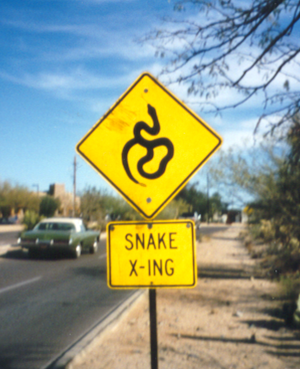
Even though we face hundreds or thousands of people in the stands or audience, both professions can be lonely. We are away from our families, we sleep in strange beds, and we talk to people we will never see again. We may be around fellow professionals, but we do not have the same openness with people that we enjoy back home.
In baseball and speaking, we often labor in the minor leagues before getting that big break. You eat cheap and rubbery lunches which you sometimes can't identify by name. In the speaking business we call them "freebies." In baseball, some of the lower levels of minor leagues may feel as though you are giving your time for free. In both careers, you cannot leave your other job until you get the big break. Some scout sees you play in Lexington or a bureau representative is in your audience in Bluefield and says to you after the game, "Can I see you for a moment? We need to talk." And it is not long before you are in the big leagues. In baseball you have the tryout and in speaking you have the showcase. Sometimes you are aware of the situation, and sometimes that key person just happens to see you play or hear you speak.
We soon learn that although we have a variety of skills and play every position or speak on lots of topics, we have to have a specialty. A baseball player may limit himself to shortstop, pitcher, catcher, reliever—or a speaker may train people in public speaking skills, or be a keynoter on attitudes, or be a seminar leader on change.
We can never please everyone. Some "fans" will not like the way we stand at the plate or deliver our message. Others may complain about how you always hit the ball into right field instead of left field, or not like your choices of stories or slides. Then we will have the fan who thinks we are the greatest and will go to any lengths to see us play or speak and even buy a film of our last speech or game.
At some point, when we arrive for another gig, we hear the words, "Play ball!" Or, in my case, I hear, "Ladies and gentlemen, I introduce our speaker…Steve Boyd."
Stephen D. Boyd, Ph.D., CSP, is Professor of Speech Communication, College of Informatics, Northern Kentucky University, near Cincinnati. He presents keynotes and seminars to corporations and associations whose people want to speak and listen effectively. See additional articles and resources at www.sboyd.com. To book Steve, call 800-727-6520 or email him through his website.