Pay Attention to Your Lottery Ticket!

You'd think if you bought a lottery ticket you would pay attention to the winning numbers when they were announced. Had it not been for a concerned wife, Eric and Lori White of Indianapolis would have lost the $2.5 million sitting on his desk. But Lori paid attention to an announcement that the money had not been claimed and the 180-day deadline was imminent. Lori texted her husband who checked his office and found the winning ticket in some books on his desk. He said, "I have no idea how they did not get thrown away."  Now they can pay for college for their two children ages 3 and 6, among other things.

  It pays to pay attention!  Look around you. What are you not observing that you should be paying attention to? I look around my office and see on the bulletin board some restaurant coupons that I should use soon. I see a couple of family pictures on my desk that should be updated. I look out my window and am reminded to purchase a squirrel-proof pole to hang my suet for winter birds.

  Weekly, go through the piles on your desk or in the catch-all drawer where you put things you plan to attend to later. You may not find $2.5 million dollars, but there could be something of value you should be paying attention to.


Pay Attention to the Words

One of the most famous lines in U. S. history was delivered by Franklin Roosevelt in his Declaration of War speech the day after Japan attacked Pearl Harbor on December 7, 1941. He began the speech with, "This is a date that will live in infamy."  The line originally read, "a day which will live in world history."  Roosevelt crossed out "world history" and replaced it with "infamy."  The changed word made all the difference in making it memorable.

  Don't use words carelessly. I admire the wordsmith who can find just the right word to express an idea. Last summer on an Empire Builder rail vacation across country, I asked the server how long he had been a waiter on the train and his response was, "25 years—a summer job run amuck."  What a great word—"amuck." 

  When someone asked a sales person why an item was so expensive, the woman replied, "Let me explain the value of this product to you."  Rita Rudner, tongue in cheek, said, "The word aerobics came about when the gym teachers got together and said, ‘If we're going to charge $10 [probably $35 today] an hour, we can't call it "jumping up and down.'"" 

  Pay attention to the words you speak. Think about words before you speak them. Is there a better way of saying this?  Listen to words others use that explain an idea better than you could have. Are these words I can use in my speaking and writing vocabulary?  Subscribe to Merriam-Webster’s online “Word of the Day.” http://www.merriam-webster.com/word/subscribe.htm  One word recently was "spurious," a word I had not often heard, but a clever way to say an action is not genuine. Even if you find the word that day is not of value to you, this discipline will remind you to focus on the words you use.

  Four years ago a movie was made that lasted only briefly in major theatres. But the title may have been one of the best titles for a movie because in four words you got the essence of the entire movie:  "Snakes on a Plane."  Of course that title told me that this was a movie I did not want to see!  As Mark Twain said, "The difference between the right word and the almost right word is the difference between lightning and the lightning bug."    


May I Ask You a Question?

A group of third graders were on a field day trip to the local police station and the sergeant in charge was taking them through the facility. They toured the jail and inspected one of the cells. Then they examined the board where the Most Wanted pictures were posted and said, "These are the people we are looking  for that belong in there," pointing to the jail. One of the third graders raised his hand and said, "Why didn't you keep them when you took their picture?" 

  Children in their innocence often go right to the heart of the matter with a question. When you ask the right question, effective communication occurs. Sometimes the right answer comes when you are two or three questions deep in the conversation. Get information before you give information. Don't be afraid to follow up one question with another.

  In most conversations you want to ask open questions rather than closed questions. Several closed questions may seem more like an interrogation to the person who has been asked the questions, whereas a well-placed open question will allow the person to give you in-depth information without feeling grilled. Instead of only asking, "What is your occupation?" add, "What are some of your professional experiences that have led you to where you are today?" 

  Avoid questions that can place the other person on the defensive such as "Shouldn't you be spending more time on this project in order to get it done on time?"  Don't begin a question with "Couldn't," "shouldn't," or "wouldn't."  Instead you might ask, "What are some things we can do to get the project finished on time?" 

  Don't be afraid to ask questions. You have probably been in a situation where you are a part of a group discussion. The speaker says something that is unclear but none of the rest of the group says anything. You don't ask the question because you feel you are the only one who does not understand and you don't want to embarrass yourself. If you finally get the courage to ask, then you find out no one else understood either. Remember that the only dumb question is the one not asked.

  Sometimes you don't ask for something because you assume the answer will be no. For example, don't take a given fee as the lowest possible price. When you are given a dollar amount for a hotel room, ask "Is that your lowest price?"  Or when you order a pizza, instead of asking for the pizza you want, begin with "What specials do you have tonight?"  All kinds of clichés come to mind with this action, such as "You never know until you ask," and "Nothing ventured, nothing gained."

  When you ask questions you are gaining information that can be helpful to you in myriad ways. As Voltaire stated, "When you listen, you have power. When you talk, you give it away."  

Stephen D. Boyd, Ph.D., CSP, is Professor of Speech Communication, College of Informatics, Northern Kentucky University, near Cincinnati. He presents keynotes and seminars to corporations and associations whose people want to speak and listen effectively. See additional articles and resources at www.sboyd.com. To book Steve, call 800-727-6520 or email him through his website.
 

Do You See What I See?

Driving the interstates in winter can be boring when you are on level land with typical Midwest harvested cornfields stretching out for miles beyond you.  I’ve discovered a way to keep my mind on the road area when the boredom begins to set in.

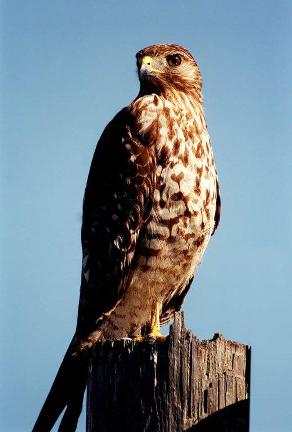
I watch for red-tailed hawks perched on fence posts or tree branches that sometimes line the highway.  In listening to a speech about the red-tailed hawk, I  learned that they are often found on a low-hanging branch or fence post in the winter time looking for prey, such as mice and other rodents, on the ground below them.  They are so still as they watch that you will typically not see them unless you look closely for their statue-like appearance on a post or branch.  Red_Tailed_Hawk

  At first I was skeptical because I had never seen one near a highway in all my years of driving. Once I began looking, I found that there are such birds on fence posts!  I was amazed.  In fact, I travel I-74 from Cincinnati to Indianapolis often and I will average seeing two red-tailed hawks for each 100 miles of driving in January and February.

  Focusing on watching for this bird keeps me alert and my eyes focused on the highway.  Knowing what to pay attention to can enhance our quality of life.  As Julia Cameron said, “The capacity for delight is the gift of paying attention.”

Paying Attention to the Little Things

Paying attention is always difficult for me. For example, I'm the one in our house who does the laundry. For years, I have simply filled the cap of the detergent bottle and poured it into the washer, oblivious to the fact (and directions on the container) that you fill the cup to different levels depending on the size of the load. My son pointed out this error of my ways when he—also the laundry person in his house—figured this out a few days ago.

    In just the past couple of years did I discover that you can tell on a rental car (or any car for that matter) which side your gas cap is on without getting out of the car to look. There is always on the dashboard an arrow on the gas gauge pointing to the appropriate side, or the icon of the gas pump will have the handle on the side the cap is on. That certainly saves time and embarrassment as I hurriedly fill my gas tank before returning the car to the rental agency so I can catch my plane. One of my new mantras is, "Pay attention, Steve, pay attention."